Guide & Explainer
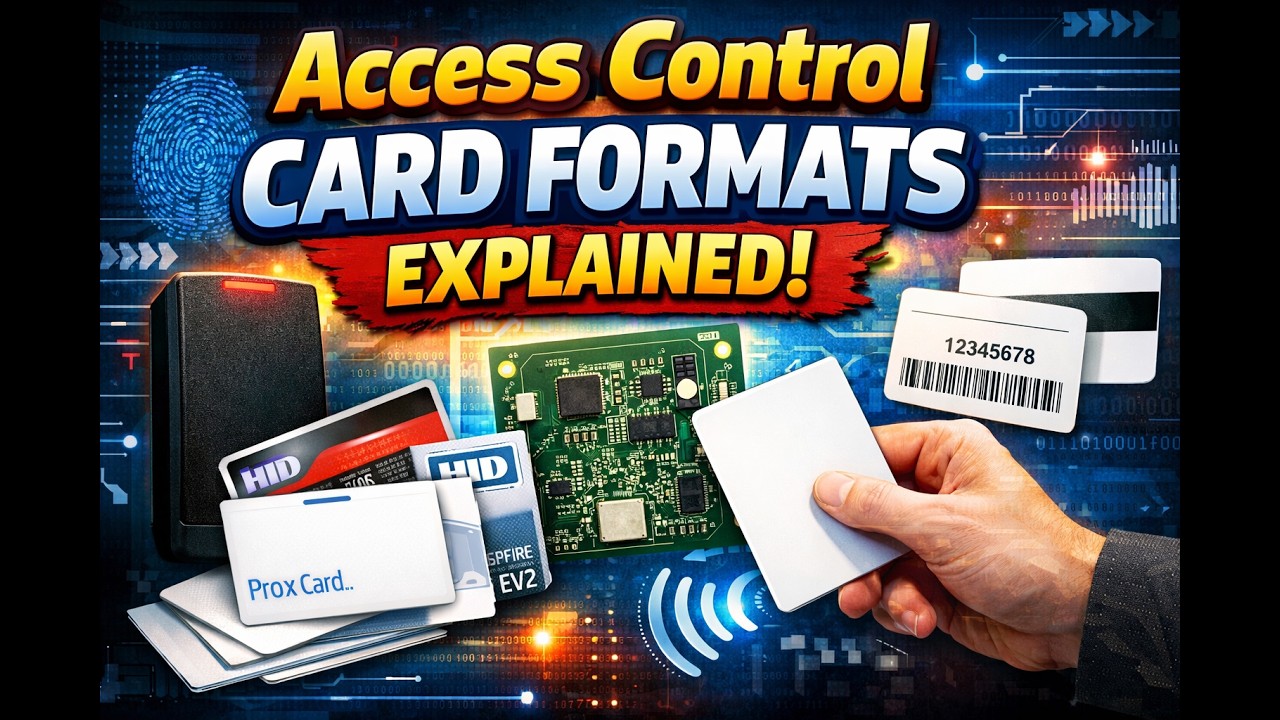
Access Control Card Formats Explained: From Magstripe to Seos
Understand common credential families and how keys, readers and controller communications affect an access-control system’s security.
Short answer
What to know
Understand common credential families and how keys, readers and controller communications affect an access-control system’s security.
Resource guide
The full explanation
If you’re managing physical security for a building, office, or campus, one of the first questions you’ll run into is what type of access control cards to use. From simple magstripe badges to advanced Seos credentials, there are a lot of options—and not all of them are created equal.
Credential technologies differ in authentication, compatibility and administration. This article explains the options; no credential provides permanent protection against every attack.
Why Access Control Card Formats Matter
The badge you hand an employee or contractor isn’t just a piece of plastic. It’s the first line of defense for your facility. Choosing the wrong card format can leave you exposed to cheap cloning devices and unauthorized access. Choosing the right one means you can secure doors, protect data, and even extend credentials into applications like printing and network login.
Common Access Control Card Types
Magnetic Stripe Cards
Magstripe badges are the old hotel keys and legacy employee cards you swipe through a reader.
- Pros: Low cost, easy to deploy, compatible with older systems.
- Cons: Magstripe data can be copied; do not rely on it for strong credential authentication.
Verdict: Outdated and insecure. Avoid whenever possible.
Proximity (125kHz Prox) Cards
Still common in office buildings, these cards are read when held near a reader.
- Pros: Contactless, inexpensive, durable.
- Cons: Many legacy 125 kHz Prox credentials transmit a static identifier without strong authentication. The 26-bit credential format and Wiegand reader wiring are separate parts of the system.
Verdict: Review legacy Prox as an upgrade candidate; contactless operation does not establish security.
MIFARE Classic
Once popular for transit systems and offices, MIFARE Classic cards run at 13.56 MHz and can hold more data.
- Pros: Multi-application capable, more advanced than Prox.
- Cons: Easy to clone with off-the-shelf tools.
Verdict: If you’re still using MIFARE Classic, it’s time to move on.
iCLASS Cards
HID’s iCLASS line introduced encryption and mutual authentication.
- Pros: Supports applications and authentication features that depend on the credential generation.
- Cons: Legacy iCLASS security, key management and reader configuration need review; the brand name alone does not establish protection.
Verdict: Identify the exact credential and configuration before deciding whether to retain it.
iCLASS SE
This is HID’s upgraded version of iCLASS, built around a secure identity model.
- Pros: Stronger encryption, customizable keys, and harder to duplicate.
- Cons: Higher cost, requires upgraded readers.
Verdict: A solid middle ground for organizations upgrading from older formats.
DESFire (EV1, EV2, EV3)
MIFARE DESFire supports AES-based authentication and multiple applications. Its protection depends on secure configuration and compatible readers.
- Pros: Enterprise-level security, fast performance, flexible design.
- Cons: Higher cost and requires more planning to take full advantage.
Verdict: Excellent for hospitals, campuses, and large corporate facilities.
Seos
Seos is HID credential technology used with compatible physical and mobile credential systems.
- Pros: Supports cryptographic authentication and compatible mobile-access workflows.
- Cons: Requires compatible readers and provisioning; pricing depends on the deployment.
Verdict: Evaluate it alongside other compatible secure-credential options.
Credential Families to Evaluate
The following is a list of credential families, not a universal security ranking. Compare key management, enabled modes and the entire reader-to-controller path:
- Magstripe
- Prox (125kHz)
- MIFARE Classic
- iCLASS Standard
- iCLASS SE
- DESFire EV1/EV2/EV3
- Seos
Which Card Format Should You Choose?
For a new system, evaluate securely configured DESFire or Seos alongside platform requirements and migration costs. Mobile access is a separate compatibility and licensing decision, not an automatic benefit of buying a particular card.
Final Thoughts
The card is only part of the result. Strong credentials can still be undermined by insecure configuration or reader wiring; evaluate secure reader-to-controller communication as well.
At 210 Solutions, we help businesses, schools, and healthcare facilities design and deploy access control systems that are secure, scalable, and built for the future.
For help applying this to your facility, explore our access control services.
Need help applying this?
Start with the problem, not the product.
Tell 210 Solutions what is happening in your building and what you need the system to accomplish.