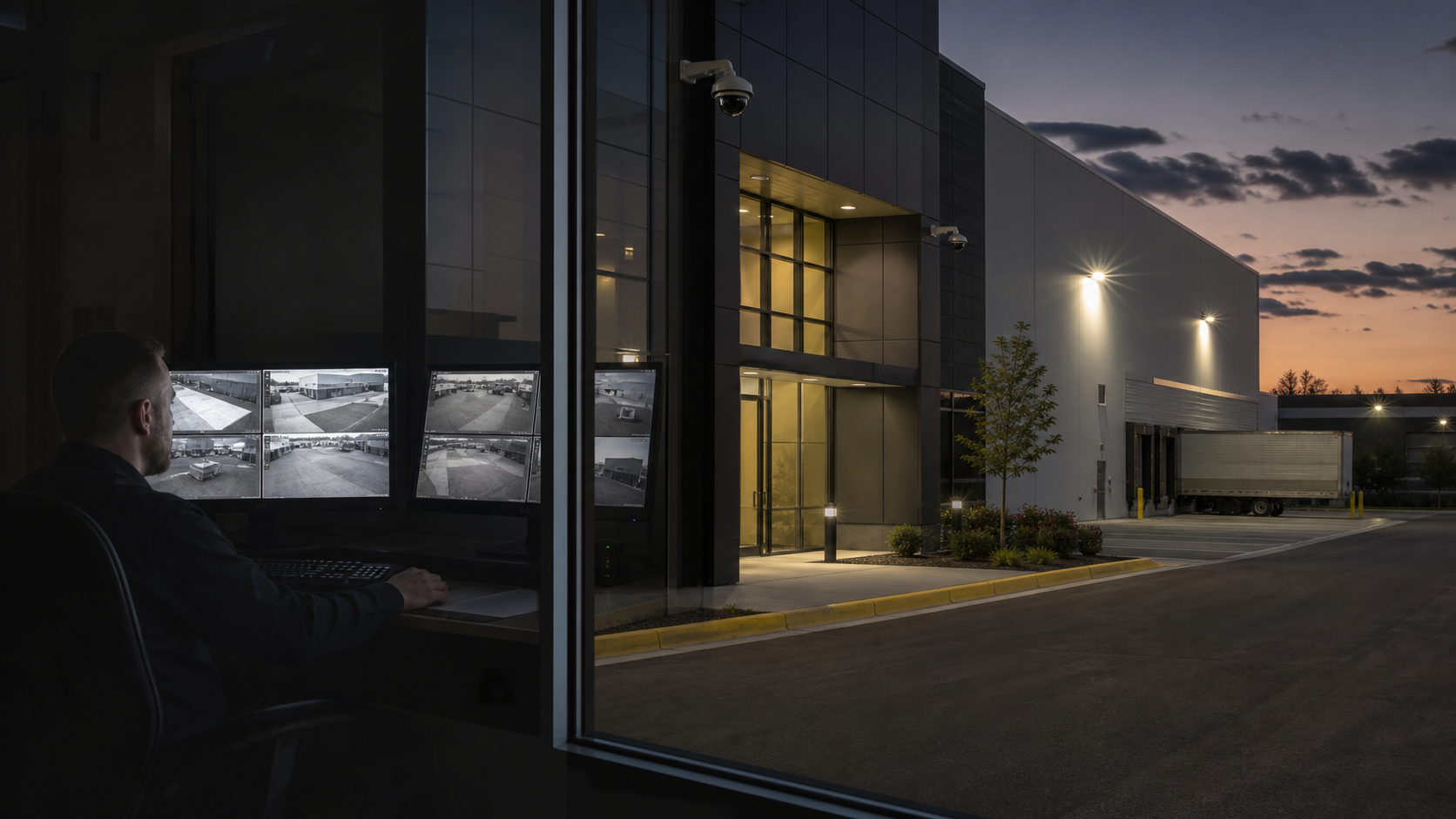
Virtual Security Guard & Remote Video Monitoring

A virtual security guard can watch defined areas, speak to people on site, and escalate verified events.

For the right property, 210 Solutions designs remote guarding around cameras, analytics, trained operator review, live or prerecorded announcements, network reliability, and a documented response plan. It can reduce dependence on continuous on-site guard coverage without pretending every situation can be handled remotely.

MEDIA PLACEHOLDER — REMOTE VIDEO MONITORINGPreferred source: original 210 field or project photographyPurpose: show the environment, workflow, or documented system conditionConceptual remote guarding response flow: detect, verify, respond, and record

The customer problem

Looking for a security guard? Some coverage may be handled remotely.

Virtual security guard monitoring can be a cost-efficient alternative or supplement for defined zones, hours, and events. Operators can verify activity, issue audio warnings where lawful, contact designated staff, and follow an approved emergency escalation plan. Police dispatch and arrival remain under local agency control and are never guaranteed.

01

Camera placement

Monitoring requires useful coverage of the zones, approaches, choke points, and activities the response plan depends on.

02

Analytics

Detection rules must match the environment, subject, schedule, weather, lighting, motion, and acceptable event volume.

03

Event verification

Operators need enough context, live and recorded views, timestamps, and procedures to decide whether an event is actionable.

04

Live operator response

A trained operator reviews verified events, can issue announcements, contact site personnel, and follow the approved escalation or emergency-response workflow.

05

Live audio deterrence

Where lawful and supported, a remote operator can use live or prerecorded announcements to let people know they are being observed, give directions, and discourage trespassing or other unwanted activity.

06

Network reliability

Bandwidth, latency, outages, power, health monitoring, remote access, and fallback behavior affect whether the service can operate.

Design factors

Define what the service can and cannot do.

  • Protected areas, operating hours, and expected events
  • Detection, verification, and acceptable false-event volume
  • Monitoring center workflow and response authority
  • Contact, escalation, dispatch, and evidence handling
  • Audio, signage, privacy, policy, and legal review
  • Network, power, cloud, health monitoring, and outage behavior
  • Testing, maintenance, reporting, and service accountability
Conceptual remote guarding response workflow

Professional judgment

The value is active intervention—not just recording.

A virtual security guard combines detection with human verification, audio response, and escalation. For suitable properties, that can cover multiple defined zones or hours more efficiently than staffing every post with a physical guard, but the result still depends on system design, monitoring operations, testing, and ongoing tuning.

Boundaries and modernization

Be precise about expectations.

Remote monitoring may improve awareness and response for selected scenarios. It does not guarantee prevention, eliminate all blind spots, or replace every physical-security role.

Explore the related service →

Credibility requirements

  • Approved related project or field experience
  • Original media or useful diagram
  • Verified technical and platform statements
  • No fear-based or guaranteed-outcome claims
PROJECT PLACEHOLDER — approved related work
RESOURCE PLACEHOLDER — practical security guide
MEDIA PLACEHOLDER — field, system, or workflow detail

Fit and Requirements

A monitoring plan has to match the property, the risk, and the response available.

Video surveillance and access control

Camera events and access-control activity can provide complementary context when compatible systems, permissions, and workflows are configured appropriately. Integration scope must be verified for the specific platforms already in place.

Network and system requirements

Useful monitoring depends on reliable camera coverage, appropriate detection configuration, stable connectivity, sufficient power and bandwidth, time synchronization, retention, permissions, and a documented escalation plan.

Virtual security guard monitoring may fit when

  • Coverage is needed for defined zones, events, or hours
  • Camera views and detection can be designed for reliable verification
  • The organization has a clear response and escalation plan
  • Remote awareness can supplement existing security operations

An on-site guard may still be appropriate when

  • Immediate physical presence or hands-on intervention is required
  • The environment needs visitor management or continuous human judgment
  • Coverage cannot be verified adequately with the available systems
  • Policy, insurance, contract, or risk requirements call for on-site staffing

Existing-System Assessment

You may not need to replace everything to find the right next step.

210 Solutions can begin by reviewing the current cameras, access control, detection, network, coverage, and operational expectations. The assessment determines what may be reused, what needs modernization, and which monitoring relationships or capabilities still require verification.

FAQ

Questions about virtual security guard monitoring.

Can a virtual security guard replace an on-site security guard?

Sometimes, for selected zones, hours, or event types. It can replace or supplement some guard coverage when the property, camera design, operator workflow, audio intervention, and escalation model support it. Sites needing immediate physical intervention may still require on-site guards.

Can an existing camera system be used?

Possibly. Camera placement, image quality, compatibility, network condition, access, detection support, and monitoring workflow all need to be assessed.

What does AI do in this type of system?

Detection analytics can help surface people, vehicles, movement, or defined events for review. They do not make autonomous security decisions or remove the need for human judgment and a documented response plan.

Can a virtual security guard reduce security costs?

It can reduce dependence on continuous on-site coverage for well-defined locations and schedules. Actual savings depend on existing cameras, network upgrades, monitoring hours, the response plan, and whether a physical guard is still needed.

Start a Project

Tell us what needs to be controlled, understood, or supported.

Start with the building, the current system, and the operational problem. 210 will help define the next step.

Start a Project