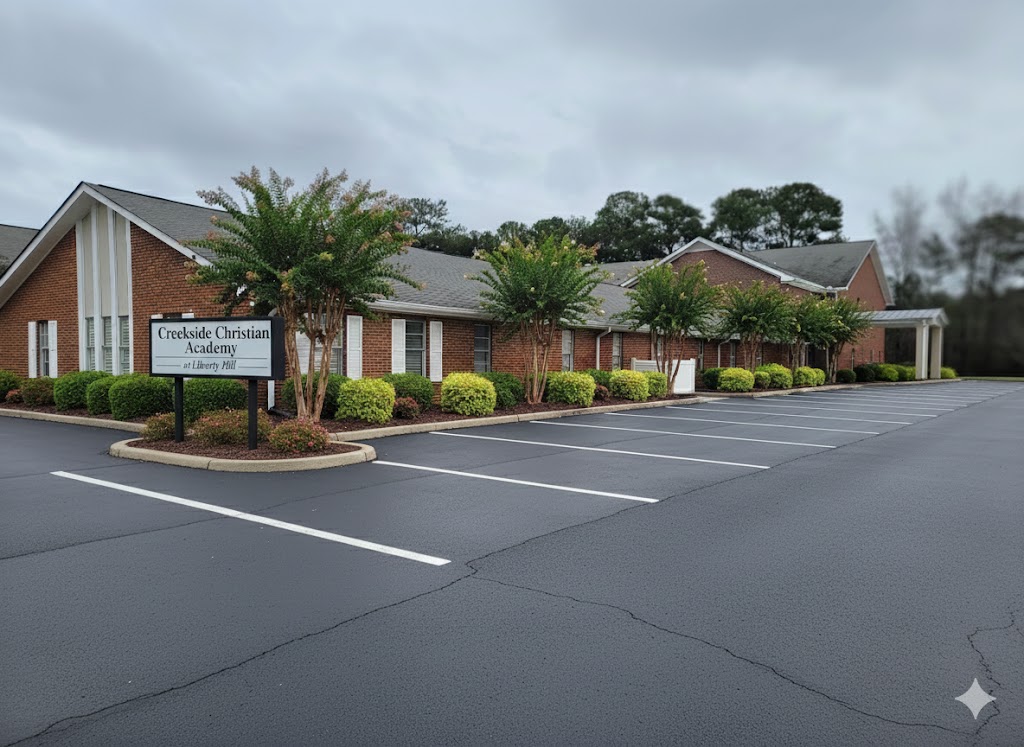
Creekside Christian Academy at Liberty Hill campus exterior in Hampton, Georgia

210 Solutions Project

Creekside Christian Academy Liberty Hill Fire Alarm Expansion

As Creekside Christian Academy prepares its Liberty Hill campus for elementary students, the building’s existing fire alarm system must expand with the new addition. 210 Solutions designed a coordinated extension that adds notification, sprinkler supervision, door-holder release, added NAC capacity, programming, testing, and commissioning without treating the addition as a disconnected system.

Creekside Christian Academy

Hampton, Georgia

The environment

Start with the environment and the operating reality.

Creekside Christian Academy announced that its elementary East campus will relocate to the Liberty Hill campus in Hampton, Georgia, beginning in August 2026. Preparing the existing church facility for students and staff requires more than classrooms and finishes; the building’s life-safety systems must grow with the new addition.

The facility already uses a Honeywell VISTA-128FBP commercial fire alarm control panel. Rather than create a separate alarm environment for the addition, the project extends the existing system so the original building and new work can operate as one coordinated life-safety system.

The challenge

A building addition changes the fire alarm problem across several layers at once. Occupants need audible and visible notification throughout the new area. Sprinkler waterflow and valve tamper conditions must report back to the existing panel. Fire doors need to release automatically during an alarm or loss of power. The added notification load also requires enough supervised power and circuit capacity.

The work must integrate cleanly with an operating system while coordinating with the sprinkler contractor, electrical conditions, available cable pathways, permitting requirements, and final review by the Authority Having Jurisdiction.

The constraints

The design is based on the existing Honeywell panel, current construction drawings, and the assumption that the installed control equipment and available pathways remain serviceable. Final device locations and counts remain subject to field conditions and AHJ approval.

Responsibilities also have to remain clear: the sprinkler contractor furnishes and installs the waterflow and tamper switches, while 210 Solutions provides the fire alarm interface, programming, supervision, testing, and points of connection.

The approach

Design the system around the people who use it.

210 Solutions planned the expansion around the existing building rather than treating the addition as an isolated system. New initiating, notification, supervisory, and door-release functions are tied back into the current Honeywell architecture, with a dedicated 10-amp notification appliance circuit power supply providing added capacity for the expanded device load.

The design combines field devices, circuit wiring, terminations, programming, synchronization, testing, and record documentation into one accountable scope. That matters in fire alarm work: the individual devices are only useful when every alarm, supervisory condition, release function, and reporting path operates together as intended.

What 210 delivered

From plan to a working, supportable system.

Scope

The planned project scope includes:

  • Extension of the existing Honeywell VISTA-128FBP fire alarm system into the new addition
  • Twenty-nine System Sensor horn/strobe notification appliances
  • Nine System Sensor strobe-only notification appliances
  • Four Fire-Lite dual-action manual pull stations
  • One Honeywell 10-amp remote NAC power supply with battery backup
  • Two electromagnetic fire-door holders with automatic alarm and power-loss release
  • Seven interface modules supporting new monitored points
  • Sprinkler waterflow and valve-tamper supervision connections
  • New fire alarm cabling, pathways, terminations, and circuit synchronization
  • Panel programming modifications, operational testing, commissioning, and record documentation
  • Coordination for final AHJ acceptance testing when required

Execution

The field work is organized as an extension of the existing system. Notification appliance circuits will be expanded through the new remote power supply, allowing the horn/strobes and strobes to operate in a coordinated, synchronized manner. Manual pull stations provide local alarm initiation points, while monitor modules bring sprinkler waterflow and valve-tamper conditions back to the main panel for the correct alarm or supervisory response.

The two magnetic door holders are integrated so protected doors release when the fire alarm activates or power is lost. After installation, 210 Solutions will update the panel programming, test every new device and circuit, verify annunciation at the existing control panel, document the modifications, and coordinate acceptance activity with the AHJ as required.

The outcome

Technology that supports the operation.

Once installed and commissioned, the expansion will give the Liberty Hill addition the audible and visible notification, manual initiation, sprinkler supervision, and door-release functions required to operate as part of the existing building-wide fire alarm system.

The practical result is one coordinated system for the facility rather than a separate collection of devices in the new space. Alarm and supervisory events return to the existing control point, notification circuits receive the additional power they need, and the completed modifications can be tested and documented as a complete life-safety workflow.

Key takeaway

A building addition should extend the fire alarm system as one coordinated, monitored whole—not leave the new space operating as a disconnected set of devices.

Plan the next project

Tell us what your building needs to do better.

Start with the people, the room, and the problem. We will help define a practical next step.