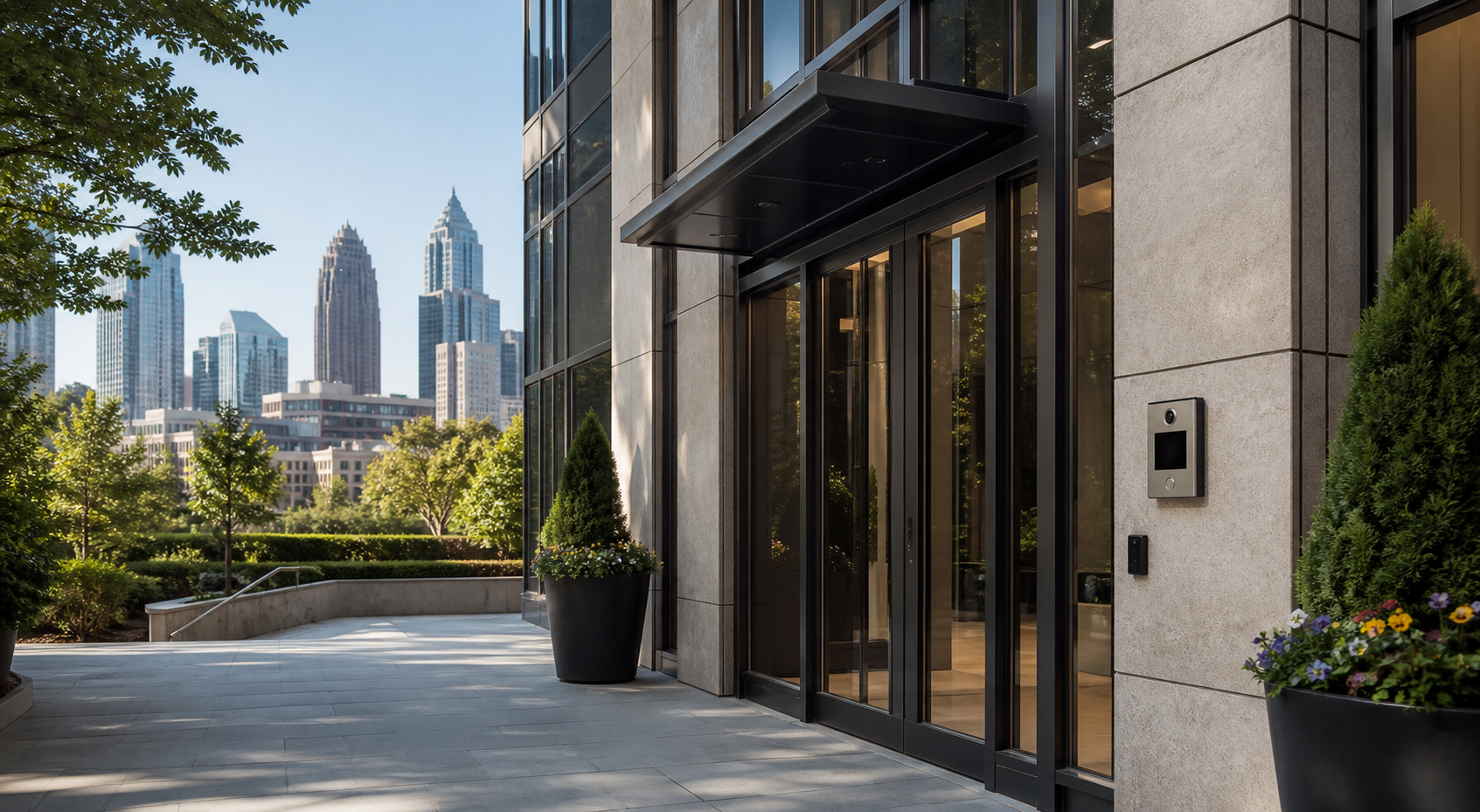
Modern Midtown Atlanta office entrance with a video intercom and access-control card reader

210 Solutions Project

Consulate General of Canada Atlanta Video Intercom & Keyscan Integration

210 Solutions restored and configured an inherited Keyscan access-control environment, trained the Consulate’s team to administer it, and added an Aiphone video intercom that lets authorized staff visually confirm visitors and release the entry door from inside the office.

Consulate General of Canada - Atlanta

Atlanta, Georgia

The environment

Start with the environment and the operating reality.

When the Consulate General of Canada moved into an Atlanta office suite, the space already contained a Keyscan access-control system. The hardware was useful, but the new occupants needed the database restored, the system configured for their operation, and practical training so their team could manage credentials confidently.

The entrance also needed a better visitor workflow. Staff needed to see who was requesting access, speak with the visitor, and release the door without leaving their work area.

The original video-intercom deployment began with two interior operator stations. Additional stations were added later as the workflow proved useful, extending the same visitor-verification capability to more appropriate points inside the office.

The challenge

Inherited access-control systems often arrive without a clean administrative handoff. A functioning reader or controller does not help much if the new organization cannot manage the database, issue credentials, or understand how its suite access fits the larger building.

The visitor-entry process created a second challenge. An audio-only call or a trip to the entrance did not give staff the combination of visual confirmation, two-way communication, and controlled release they wanted.

The constraints

The solution needed to work with the existing Keyscan environment rather than replace a serviceable system. It also had to coordinate with the building’s established credentialing process so approved personnel could use one credential across the access points assigned to them.

Because this is a security-sensitive office, the public case study intentionally omits exact access-point locations, credential rules, database architecture, and system configuration details.

The approach

Design the system around the people who use it.

210 Solutions treated the work as both an integration project and an operational handoff. The team brought the inherited Keyscan database into working order, confirmed the access-control workflow, and trained the client’s administrators on the everyday tasks they would actually perform.

An Aiphone video-entry intercom was integrated with the controlled entrance. When a visitor calls, authorized staff can view the visitor, communicate with them, and press a release control to unlock the door.

The original master and secondary stations established the workflow. Later additions extended the intercom to more staff locations without changing how the system is used.

What 210 delivered

From plan to a working, supportable system.

Scope

The completed project included:

  • Assessment and recovery of the inherited Keyscan access-control environment
  • Keyscan database configuration and administrative setup
  • Client training for credential and access-management workflows
  • Coordination of the client’s authorized suite access with the building’s credential system
  • An Aiphone video-entry intercom with interior master and secondary operator stations
  • Visual visitor confirmation and two-way communication
  • Push-button release of the controlled entry door
  • Later expansion with additional interior intercom stations
  • Testing, commissioning, documentation, and support

Execution

210 Solutions first stabilized the access-control administration so the Consulate’s staff could use the existing Keyscan system rather than inherit an unmanaged black box. Database records and day-to-day workflows were organized, tested, and reviewed during hands-on training.

The video intercom was then installed and connected to the entry-release workflow. The team verified camera viewing, two-way speech, call notification, and door-release operation from the interior stations.

After the initial system was in use, 210 Solutions returned to add further stations within the office. The expansion preserved the same simple operating model: identify the visitor, speak with them, and release the door when appropriate.

The outcome

Technology that supports the operation.

The Consulate’s staff gained a clearer, faster visitor-entry process. They can visually confirm who is at the entrance, communicate before granting access, and unlock the door without sending someone to meet every caller.

The Keyscan work also gave the organization control over an inherited system. Administrators received a working database and the training needed to manage approved users and credentials.

For authorized personnel, the coordinated credential workflow reduces the need to carry separate cards for different parts of the property. The later intercom expansion demonstrates that a small, well-designed improvement can become a repeatable building workflow.

Key takeaway

A useful entry system is more than a camera or a card reader. This project combined visitor verification, controlled door release, a recoverable Keyscan database, and practical staff training into one understandable access workflow.

Plan the next project

Tell us what your building needs to do better.

Start with the people, the room, and the problem. We will help define a practical next step.